Filippo Tomaso Marinetti
, 1913
His story begins on February 20, 1909 in Paris with the publication of the first Futurist manifesto in the mass-circulation newspaper Le Figaro. Its author, the Italian poet Filippo Tommaso Marinetti, who announced the principles of free verse he had taken in his writings. On December 11, 1896, Alfred Jarry had submitted an inventive and remarkable performance when he began his absurd antics representation of Ubu Roi (King Ubu) at the Théâtre de l'Oeuvre of Lugne-Poe. The work was modeled on college farces of the early days of Jarry in Rennes and puppet theater that had directed in 1888 in the attic of his childhood home under the Théâtre des Phynances title. Work during the pear Ubu delivered the beginning of the text, one word: <
First Futurist evening
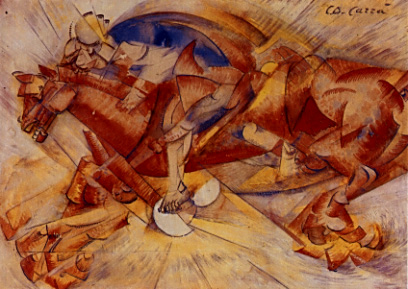
Cartoon
a Futurist evening by Boccioni, 1911
In Rome, Milan, Naples and Florence, the artists were campaigning for intervention against Austria. So that Marinetti and his companions went to Trieste, the key border town in the Austro-Italian and represented the first evening (Serato) future of this city on 12 January 1910 at the Teatro Rossetti. Marinetti protested furiously against the cult of tradition and the commercialization of art, singing the praises of patriotic militarism and war. The fame of the Futurists as troublemakers and were created. The Austrian consulate in the Italian government gave an official complaint, and the following evening futurists were closely watched by big battalions of police.
The Futurist painters become
interpreters Marinetti, along with Umberto Boccioni, Carlo Carrà, Luigi Russolo, Gino Severini and Giacomo Balla, published on March 8, 1910 the Technical Manifesto of Futurist Painting. After using Orphism Cubism and to modernize the look of his paintings, young people became some of the futuristic ideas of speed and passion to the danger of a cyanotype original manifesto for Futurist Painting. On April 30, 1911, a year after the publication in Milan opened the first exhibition of paintings collectively under the umbrella futuristic works Carrà, Boccioni and Russolo and others. "The gesture for us is no longer a fixed moment of momentum universal dynamic sensation will be decisively made eternal. "
Futurist Painters began work on the performance as the most direct method of forcing the public to take note of their ideas. For example, Boccioni had written that <
course, another aspect of this form of cabaret that was attractive to Marinetti was the fact that it was anti-academic, primitive and naive, therefore even more important by the unexpected discoveries and the simplicity of its means. Consequently, the logic flow of Marinetti, the music hall destroys the Solemn, the Sacred, the Serious and the Sublime in Art with a capital. And finally, as a bonus, the Music Hall offered to all countries (like Italy) do not have a single capital as a brilliant summary of Paris, considered the only magnetic center of luxury and pleasure ultrarrefinado


0 comments:
Post a Comment