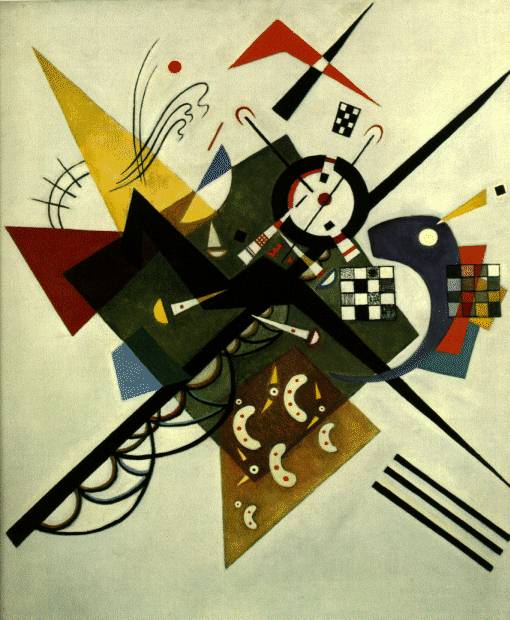
In general téminos "abstraction" means a type of plastic art expression does not represent anything specific or recognizable material reality that has outlived its usefulness in terms of itself, born of the need for free expression of the artist, which is based in their own language (the language of lines, colors and maternal effects of the pigments alone or mixed with other materials) . This kind of artistic expression as an aesthetic category was consolidated during the twentieth century different positions in their language ( Rayism , Suprematism , Orphism , Neo , concreteness, action painting, informality, postpictórica abstraction, op-art, neo-geo ). The Beginning of abstacción occurs around 1912 with the work of artists Kandinsky and Klee (Kandinsky data in 1910 his work entitled "First Abstract Watercolor). These two artists were part of the Expressionist group Der Blaue Reiter (Rider blue) and like the expressionist Die Brücke (The Bridge) , his zeal was on the renewal of art, the search for the essential and the rejection of Impressionism and materialistic positivism prevailing in his time. But unlike the Die Brücke Expressionism , works of Der Blaue Reiter were more lyrical (lines dominate them curves and soft colors, as opposed to the broken lines and colors of esaltados Die Brücke). Besides artists Der Blaue Reiter , especially Kandinsky had a desire to reclaim the spiritual meaning of art. This led them to orient their work towards a reflective and serene purification of material to achieve and represent the essence of what real.es through this process of spiritual cleansing calm, Kandinsky came to abstraction. This process is manifested in many works in which he rehearses his aesthetic and appreciate those elements that still remain regarding specific motif (mountains, buildings, trees, etc.).. From 1913, those reasons disappear and the work of Kandinsky is all non-figurative. FEATURES
- Rejection of all objective representation of reality .- Evaluation of the subjective and the symbolic ( Kandinsky abstraction conceived a philosophical and mystical approach whose budgets are reflected in his book "Concerning the Spiritual in art ) .- Graphic Design-plastic based on:
- intuitive creativity (Kandinsky ): abstract shapes arising from impressions caused by the observation of the nature of improvisation responding to spontaneous emotional impulses with random intervention, and compositions arising from internal emotions consciously calculated with the help of reason.
- reducing subjective reality (Klee ): abstract forms drawn from the subjective reality by reducing the contents aparienciales of things symbolic visual signs of the objective world, in terms of fantasy and spiritual sensitivity .- Reduction of painting itself: the color becomes his method, object and subject .- In general, no clear content (Kandinsky ) .- Lack of perspective or of any spatial illusion convencionaliso .- Use of spots and lines with random findings .- Color free.
One of the historians and sociologists of art most unjustly neglected and misunderstood by the fleeting and, in turn, versatile and enduring fashions that seem to permeate all current methodologies regarding the interpretation of historical and artistic events during the past years, Arnold Hauser, was probably right when he wrote more than three decades of the twentieth century had begun in 1914 with the collapse of an entire social and political order remained long unanswered successful of any kind.
Now that with increasing emphasis is almost sickening taste morbidity the end of this century, which is expected to arrive soon chronological death, we further as it is about those who feel that perhaps we are witnessing the fulfillment of a historical cycle that started from the point culturally and, therefore, also socio-historical with the avant-garde of the early century, in the decade we are going through, once produced the tail of the vanguards of the sixties and seventies, the natural conclusion without This means that the new and still for long, hazy period ahead could do without most of the immense and inexhaustible legacy handed by the experiences of the historical avant-garde. Indeed, even though it is difficult to see now the time of delivery, eighty-synonymous with confusion and eclecticism, are a transitional period of gestation of a new and enigmatic creature.
Precisely at this moment, when we are given a cool retrospective on the achievements and shortcomings of the artistic achievements of our more immediate past, we confirm and verify an old feeling: the most radical achievements within the plastic of the twentieth century avant-garde are due in large part, as a powerful undercurrent it were, the perfect assimilation protagonists of the theoretical, aesthetic and philosophical, which form the Romantic movement, born of the crisis that almost from the very beginning will be plunged previous neoclassical movement.
We can not all lines are noted in each case the above sentiment, suffice it to refer the reader to the excellent essay by Robert Rosenblum's Modern Painting and the Nordic tradition of Romanticism (1975), which is discussed interpretative hypothesis evocative detail about modern art.
Yes, however, defend the romantic impression of affiliation that runs through the grooves in the paint forefront, providing evidence that we provided in three key names plastic production in the first half of the century, Kandinsky, Malevich and Mondrian. In drawing these three emblematic figures of pictorial abstraction, by which the language forms may reach the highest levels of harmonic conjunction with the subject and spirit of the universe, implicitly deny the arbitrary division between an art academic subject to cold rigor of pure geometry and other violent swings attached to personal temperament, at least in this dichotomy has, when used without delving into the issue of artistic styles, simplistic reductionism and empty. Risking
look and think without prejudice on the black square on white background (shown for the first time in 1915) and the white square on white (1918), both painted by Malevich, is always an act of courage aesthetics, in which probably end up then reveals secrets that remained hidden in ourselves. Tells us the artist in his most important theoretical work, Suprematism as the non-representation model (1920), did not understand and his contemporaries: "For Suprematism I understand the supremacy of pure feeling in art (...) When in 1913, in my desperate attempt rid of unnecessary weight to the art object, sought refuge in the form of a square and set out a box that did not represent but a black square on white background, the critics complained, and with it the public saying: "Whatever we loved is lost; we are in a desert before us stands a black square on white background (...) The ascent to the summit of non-figurative art is painful and full of torment (...) but also satisfactory. The usual things recede more and more, to each step taken, the objects are away until finally the world of common notions, which yet we live, is completely broken. Enough pictures of reality, enough ideal representations, only the desert. But this desert is imbued with the spirit of the sensitivity undeniable that pervades everything. " Was not too painful route followed by the romantic soul? But do not just turn, finding the light and knowledge that emerge from the inner self communion with nature? Maybe this "undeniable spirit of sensitivity" is nothing more than the feeling of pure "wilderness" once it has penetrated the mystery of the real.
Kandinsky, Malevich Russian as well, had a very balanced emotional sense of color, such a predisposition to the lyric line geometry (both communication vehicles to the world), that his paintings are translated into a perfect and pure symbolic expression. All aesthetic conception can be summarized in one sentence: the artist must meet the call of "inner necessity." From the time of your search appears linked to that "inner sound", the artist relates his work to the world of subjectivity, in the tradition of romantic spirituality. But Kandinsky, in a sense the most abstract of contemporary painters, at least if we ignore the elaborate rationale that argues in his theoretical writings, especially in its brief and legendary book Concerning the Spiritual in Art (1912) - away from the romantic at a turning point, which made them guardians of the sacred fire of the imagination, making one of the largest natural springs of his creative powers. Kandinsky stands in defense of pure abstraction, absolutely pristine, from which the picture becomes subject. However, the aforementioned book explains not enough (perhaps because it is impossible from a rational point of view) to see Kandinsky discontinuity in the universe, the lack of contact between the noumenal and the phenomenal. The purported goal of seeking "the interior on the outside" use "value inside the outer" foundation of the radical separation between art and nature, are set out by Kandinsky, "The harmony of colors should be based solely on the principle of adequate contact with the human soul." I think, however, that not only disregards the nature Kandinsky, because as any true artist is connected to a sense of cosmic no conception reaffirm one of the keys to romance: the value of the subjective.
The case of Dutch Piet Mondrian is certainly more complicated than that of Malevich and Kandinsky, here we limit ourselves, as in the above, to sketch it. On the one hand, the founder, along with Van Doesburg, the Neo, only seems to conceive of art from the point of view of absolute abstract. Straight lines that intersect in the plane, with no bias, according to a horizontal-vertical rhythm, so-called classical period of their production (1928-1932), uses only pure colors (red, yellow, blue) and non-colors (white, black, gray), subject all mates composition and proportion.
Mondrian in his writings rejects any concession to paint what he calls the romantic treatment of the subject, unable to express what "concrete" which makes abstract art: "The mistaken belief that it is possible to express the deepest essence of a existing thing through their translation, reduced painting symbolism and romanticism, the mania for "describe." A similar art is, in greater or lesser extent, an illusion, a fantasy, and, not being very real in the sense that we give to this word, stay out of life. " Mondrian Romanticism means for light-dark, sense of tragedy, poverty or human weakness. Neoplastic fabric replaced every form of naturalism for clarity and simplicity, the pure creation of the spirit. While Malevich, said Juan Eduardo Cirlot, insists on the attainment of a certain type of relationships that make the search sensitive interior of the artist Mondrian looking for the feeling order, as compensation for the destruction of the world, while looking for the danger that the indefinite probability of unstable relationships, it was looking on the side of the infinite variety of stable situations.
But this Piet Mondrian wrote that "far from ignoring the individual nature of man or of losing the" human note "purely plastic art is reconciling the individual with the universal." The initiate in theosophy and knowledge of Far Eastern philosophies, the ascetic, that "prophesies the end of art by its reabsorption in life itself" (Michel Seuphor), was, as every true man and artist, a permanent paradox. Listen to the words of his friend Seuphor, who tried hard, marveling at his mystique, "Mondrian, announcing the end art, demonstrated through his life and his work that he believed strongly in the moral value of art and not intended to no compromise on that point. He had a belief of his artistic vocation and the dignity of art that he believed everything had are subordinate. Also, take in the art to religion and knew well that what art is art has never been defined or explained. The most rational of men was not entirely rational


0 comments:
Post a Comment